
- Home
- Commercial
- Industrial & Warehousing
Industrial and warehouse pest control
Southern Pest Co runs pest management programs for warehouses, workshops and industrial sites across Southern Sydney — scheduled rodent baiting for racking and loading docks, stored-product pest monitoring, bird-proofing referrals and audit-ready documentation. Programs are built per site after a free survey, with monitoring station maps and digital reports.
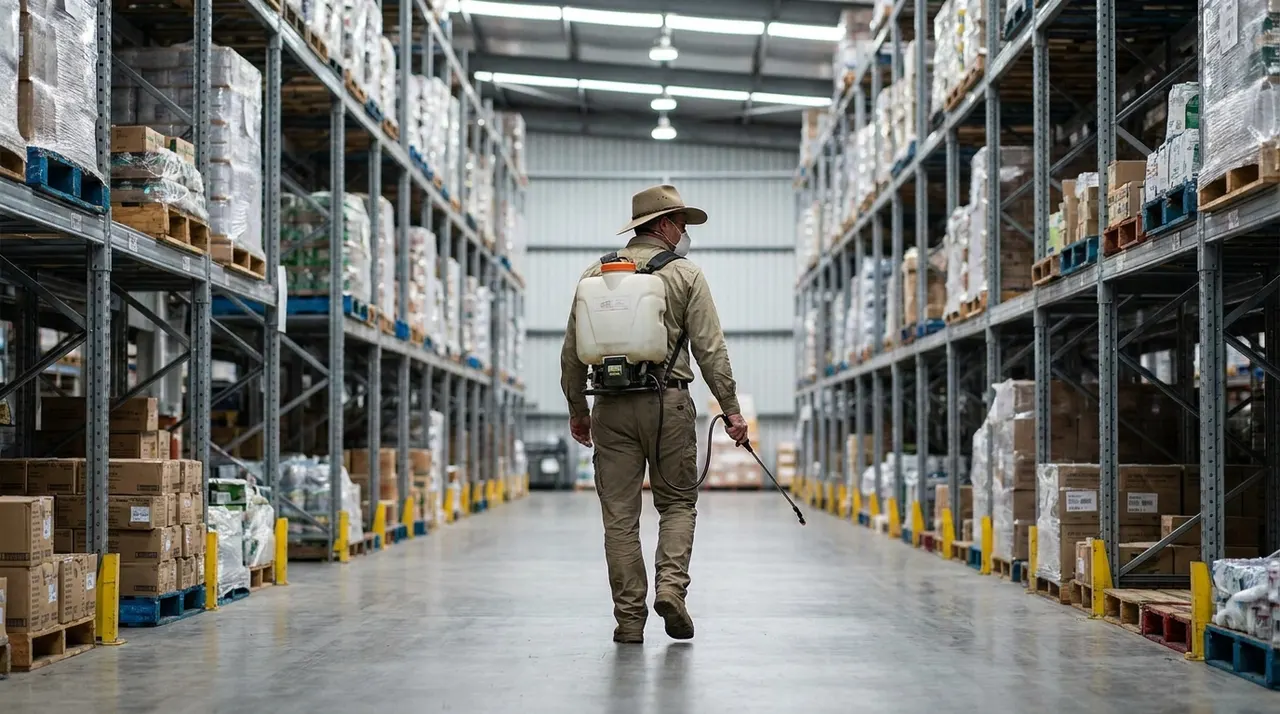
How a warehouse rodent program works
A big open building with constant vehicle movement is an open invitation to rodents, and the way to control them is a system, not a bag of bait. We start with a site survey: we walk the floor, the perimeter and the roof line, and mark the pressure points — loading docks, roller doors, waste and recycling areas, wall penetrations and the racking runs rodents use as highways.
From that we build a network of numbered, tamper-resistant stations — external stations around the perimeter to intercept rodents before they enter, and internal monitors at dock edges, racking bases and back-of-house areas. Every station has a fixed position on the site plan and a set service interval. On each visit the technician checks every point, records what was found, tops up or replaces as needed, and updates the trend so you can see whether activity is climbing or holding. Baiting alone never fixes a site that stays open, so the program is paired with proofing advice — door seals, gaps, housekeeping around the dock — because keeping rodents out is cheaper than killing them once they're in. For the species detail behind the program, ourrodent control page covers roof rats, sewer rats and mice.
Stored-product and fabric pests
Rodents are the headline, but a warehouse holding food, packaging, textiles or paper has quieter problems. Stored-product moths and beetles get in with incoming stock and breed in pallet loads that sit too long; fabric and paper pests damage stored goods without anyone noticing until a line is ruined. We add monitoring — pheromone and insect monitors placed through storage zones — so an infestation is caught while it's small and traceable to a source, rather than found when a customer complains. Where birds are roosting over docks or in the roof structure, we assess it and refer proofing work as needed rather than overclaim on it.
Documentation your auditor will accept
For an industrial site, the pest file is half the job. Retailer, GFSI and third-party audits want to see that pests are controlled and that you can prove it. Every program comes with a current site plan showing every numbered station and monitor, a service log for each visit, trend reporting over time, and product and licence records — the complete file an auditor asks for, kept current between visits so it's ready when they arrive unannounced.
Where a site stores or handles food, the requirement has a name: Food Safety Standard 3.2.2 of the FSANZ Food Standards Code requires a food business to take all practicable measures to prevent pests entering the premises and to eradicate and prevent their harbourage. A documented pest management program is how you evidence that a HACCP-based food safety plan controls the pest hazard, and it's what your auditor and the NSW Food Authority expect to see. We build the program to support that requirement — the standard is the obligation, the documentation is the proof. Our technicians are also inductions- and SWMS-ready for sites that require site-specific safety paperwork before work begins.
Local industrial precincts
Southern Sydney has real industrial pockets, and we work them. The Caringbah industrial area runs workshops, trade suppliers and distribution units behind the residential streets, and the West Botany Street corridor at Rockdale carries warehousing and logistics along the airport approach. Servicing these precincts means we're close enough to respond quickly and familiar with the building stock — the tilt-slab sheds, the older brick units, the mixed light-industrial estates. Whether the site sits in the Caringbah pocket or along theRockdale corridor, we service it on a schedule that fits your operation rather than ours.
Contract or per-visit
Most warehouses are best served by a scheduled program — it keeps the records auditors expect and catches problems early — but it isn't the only way to work with us. If you face a one-off problem, a sudden rodent surge, a stored-product infestation in a single line or a nest over a dock, we'll attend and quote that job on its own, with no obligation to sign a program. We'll give you the honest recommendation for your site and let you choose. Site surveys and quotes are free, scheduled-program pricing is fixed for the term, and every technician holds a current NSW EPA pest management technician licence. See the commercial pest control hub for how our programs work across other business types.
Frequently asked questions
How does a warehouse pest program work?
We survey the site, map the pressure points — loading docks, roller doors, racking, waste areas — and place a network of numbered, tamper-resistant rodent stations along the walls and entry points. Each station is checked on a set schedule, logged with what was found, and the trend is reported back so you can see whether pressure is rising or under control.
What documentation do audits require?
Third-party and retailer audits typically want a current site plan showing every numbered bait and monitor, a service log for each visit, a trend report over time, and product and licence records. We supply all of it as standard, so when an auditor asks for your pest file it is complete and up to date rather than assembled in a panic.
How do you handle rodents in racking and loading docks?
Docks and roller doors are where rodents get in, and racking is where they hide and travel. We concentrate monitoring at those points — perimeter stations along external walls, internal monitors at dock edges and racking runs — and pair it with proofing advice on door seals, gaps and housekeeping, because bait alone never fixes a site that stays open to them.
Do you do one-off industrial jobs or contracts only?
Both. A scheduled program is the right fit for most warehouses and any site facing an audit, because it gives you the ongoing records auditors expect. But we also handle one-off jobs — a sudden rodent problem, a wasp nest over a dock, a stored-product infestation in a single line — quoted per visit with no obligation to sign up to a program.
Do you service sites outside the Shire and St George?
Our core service area is the Sutherland Shire and St George, and that's where we're fastest. For industrial sites on the edge of that area, it depends on the job — call us with the address and we'll tell you straight whether we're the right fit or point you to someone closer.
Book a free site survey
Same-week service across the Sutherland Shire and St George. If covered pests come back within the service warranty period, so do we — at no charge.